
🛑 Beyond the Margaritas: What Expats in Mexico Need to Know About Risk, Law, and Respect
- MovingHelpCenter.com

- Sep 15, 2025
- 5 min read
There’s a story that gets told in every Facebook group, every YouTube vlog, every dreamy blog post about moving to Mexico. It goes something like this: “I left the chaos of the U.S. or Canada, crossed the border, and now I sip margaritas under the sun while my cost of living is cut in half.”
It’s seductive. It’s marketable. And it’s incomplete.

Because behind the palm trees and pastel-colored casitas, there’s another reality—one that’s rarely posted, but increasingly urgent: expats in Mexico are facing rising legal risks, cultural backlash, and a growing need for humility and accountability.
🚨 Arrests Are Rising - and Not Just for Cartel Crimes
Between 2017 and 2023, over 2,600 U.S. citizens were arrested in Mexico, a 457% increase compared to the previous administration. While some of these arrests involve serious offenses like drug and arms trafficking, others are far more troubling.
There are Americans who’ve been detained for nothing more than being in the wrong place at the wrong time - or for refusing to pay off a corrupt officer. Juan Carlos García Cortés, a local motorcyclist in Mexico City was kidnapped and beaten by members of a special police force. They demanded $50,000 pesos in exchange for his release. He wasn’t a criminal - he was a target, a Mexican born one.
Another report from Chiapas revealed 92 municipal police officers arrested for using surveillance cameras to tip off cartel-linked groups, and even drawing guns on state officials. These aren’t isolated incidents - they’re part of a broader pattern of abuse and impunity by Mexican law enforcement - the same ones with access to a new demographic: ¡Hola, gringo!.
Expats have been detained for:
Driving under the influence
Possession of controlled substances
Real estate fraud
Visa violations
Refusing bribes or questioning authority
Mexico is not a lawless playground. It’s a sovereign nation with its own legal system, cultural expectations, and consequences. And it’s enforcing them—with or without fairness.
Arbitrary Detention
In September, the UN Working Group on Arbitrary Detention presented the findings from its 2023 visit to Mexico. The working group expressed concern that “arbitrary detention remains a widespread practice in Mexico and is too often the catalyst for ill-treatment, torture, enforced disappearance and arbitrary executions.”
Authorities often misuse the in flagrante provision in Mexican law, which allows them to arrest a person caught in the act of committing a crime, by “planting drugs in their homes, vehicles, bags, or clothes” to detain people and question or torture them without a lawyer present, the working group found.
People accused of crimes often face extended periods of pre-trial detention. Approximately 37 percent of incarcerated people in 2023 were not convicted of any crime and more than 20 percent of those in pre-trial detention had been there for more than two years. Judges are legally required to order pretrial detention for those accused of more than a dozen categories of crime, without evaluating the circumstances of the case, which violates international human rights standards.
In November, Congress approved a constitutional amendment to expand the list of crimes requiring mandatory pre-trial detention, in violation of rulings by the Inter-American Court of Human Rights, which had ordered Mexico to eliminate the practice.
🇲🇽 Metropolitan Mayhem
An expat in Monterrey recounted being stopped by a local officer while walking to the corner store near his home. The officer saw he came from the largest house on the block and, after hearing his accent, the cop concluded he wasn’t Mexican - a proposition was made.
An offer you can't refuse:
"If you want to go home today, I need something from you"
When the expat refused to pay a $3,400 peso bribe, the officer fabricated a charge and arrested him. He spent 30 days in prison, paid over $140,000 pesos in legal fees, and witnessed firsthand how many foreigners were locked up in a Mexican prison (pre-trial detainment) - most of them clearly not criminals. “It’s a new way for them to make money,” he said. “And it’s working.”
🧾 Visa Confusion Can Lead to Deportation
Many newcomers arrive on tourist visas and assume they can “figure it out later.” But overstaying, misrepresenting your purpose, or working without proper documentation can lead to fines, deportation, or blacklisting from re-entry.
The visa process is layered and often inconsistent across regions. Some INM offices require documents others don’t. Some expats hire lawyers to navigate the maze - others spin their wheels and risk legal trouble.
As one expat put it:
“I thought I could just renew online. Turns out I was flagged and nearly deported. Lesson learned.”
🏠 Real Estate Isn’t Always Safe
Buying property in Mexico - especially in restricted zones near coastlines or borders -requires navigating the fideicomiso trust system. Scams are common. Contracts may be invalid. And notarios (not regular lawyers) are required to finalize deals.
Expats have lost tens of thousands due to:
Fake listings
Unclear title transfers
Unlicensed agents
Misunderstood zoning laws
If you’re buying, get legal help. If you’re renting, read the fine print. And if it feels too good to be true - it probably is.
🧠 Cultural Entitlement Is Getting Pushback
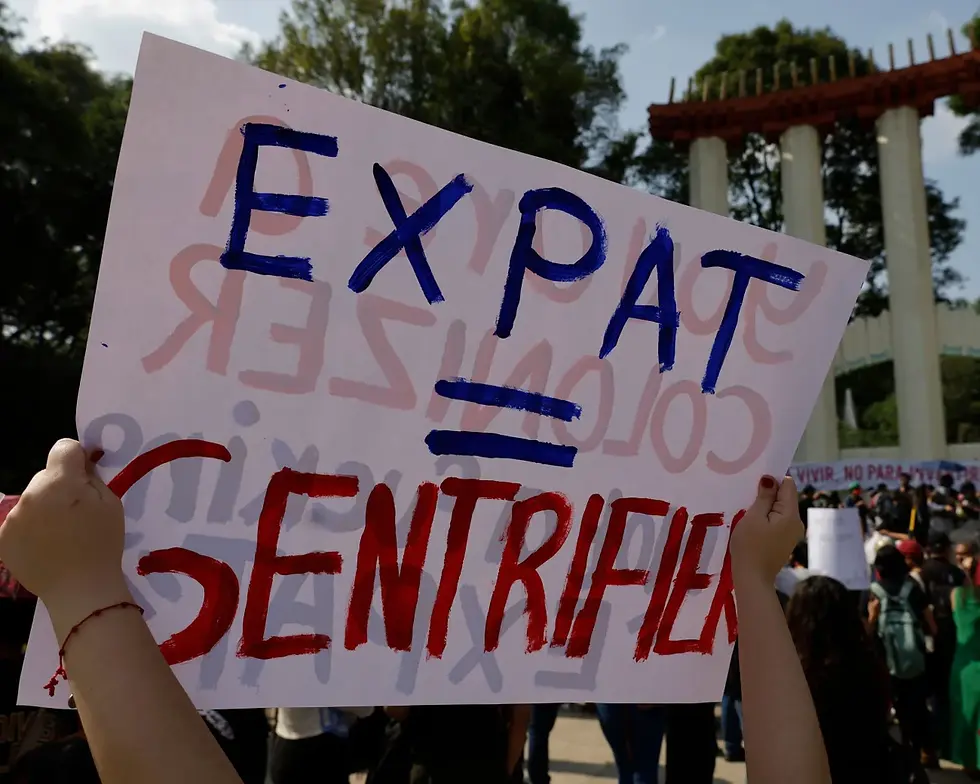
In cities across Mexico, locals are voicing frustration. Graffiti reads “Gringos, stop stealing our home.” Rents are rising. Neighborhoods are gentrifying. And some expats are behaving like colonizers, not guests.
This isn’t about guilt - it’s about respect.
Living in Mexico means:
Learning the language
Supporting local businesses
Understanding social norms
Listening more than speaking
You are not immune. You are not above. You are part of a shared space - and that requires shared responsibility.
🧭 The Real Expat Life Is Layered, Not Escapist
The truth is, Mexico can be beautiful, healing, and transformative. But only if you show up with humility, curiosity, and a willingness to adapt.
It’s not just about sunny days. It’s about:
Navigating bureaucracy
Building trust with locals
Respecting the law
Owning your impact
So before you post another beach selfie or tell someone to “just move down here,” ask yourself: *Are you living in Mexico - or just using it?
Have you or someone you know experienced the realities of expat life in Mexico - whether uplifting, challenging, or unjust? Share your story in the comments below. Your voice matters.
📚 Sources & Further Reading
U.S. Citizen Arrests in Mexico & Human Rights Reports
Mexico 2024 Human Rights Report – U.S. Department of StateMexico Country Report – U.S. Department of State
Visa Violations & Entry Requirements
Mexico Travel Advisory – Travel.State.govVisa Denials & Ineligibility – Travel.State.gov
Real Estate & Financial Scams Abroad
Cultural Backlash & Gentrification in Mexico City
Mexico City Residents Are Fed Up With Gentrification – MarketplacePhoto Essay on Gentrification – Trinity College


Comments